

Why the right tech stack matters in the messy middle
Growing businesses rarely struggle because they don’t have enough technology.
More often, they struggle because they have too much technology, not enough strategy behind it, and the false hope that one more platform will finally fix the chaos.
The right tech stack can help a growing business scale. It can improve visibility, reduce manual work, support accountability, and create a better experience for both your team and your customers.
But more software does not automatically create more efficiency.
In many founder-led businesses, the wrong tech stack creates a new kind of mess: more logins, more subscriptions, more duplicate data, more workarounds, more frustration, and more time spent managing systems instead of running the business.
In the messy middle, technology should reduce complexity, not add to it.
This is part seven of our Scaling Through the Messy Middle series.
What Is the Right Tech Stack for a Growing Business?
The right tech stack for a growing business is a set of tools that work together to support operations, reporting, decision-making, and growth without duplicating work or adding unnecessary complexity.
It should fit the way your business actually runs, support your team, and allow information to move cleanly across the business, rather than getting stuck in separate systems, spreadsheets, or individual team members’ heads.
Why the Wrong Tech Stack Creates More Chaos
As businesses grow, systems often stop matching the way the company actually operates.
What once felt manageable starts to break down.
It usually happens gradually. A payroll system is added. A CRM is layered in. Someone starts using a project management tool. Someone else builds a spreadsheet workaround. Before long, the business is relying on a patchwork of software that was never intentionally designed to work together.
A new platform may have been added to solve one problem, only to create two more.
The result is not just inefficiency. It’s reporting gaps, inconsistent processes, decision fatigue, and a team that spends too much time navigating systems instead of doing meaningful work.
How Do You Choose Business Software Without Adding Complexity?
Before choosing a new platform, start by asking a better question: What does the business need to operate more clearly, consistently, and effectively? The best tech stack is not the most advanced or the most popular. It is the one that fits your workflows, solves real problems, and can grow with your business without creating more confusion behind the scenes.
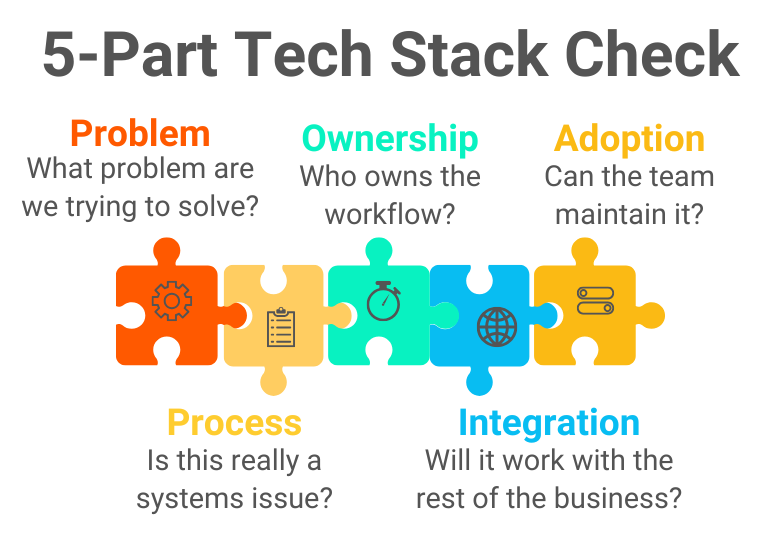 The 5-Part Tech Stack Check
If you are evaluating business software during a period of growth, this is a practical place to start.
1. Problem
What problem are we actually trying to solve?
Be specific.
Are you lacking visibility into cash flow? Are manual processes consuming too much time? Are errors happening because systems are disconnected? Is onboarding inconsistent? Are approvals too dependent on one person? Is your team relying on spreadsheets because your current software no longer supports the business well?
If the problem is unclear, the solution usually will be too.
2. Process
Is this a systems issue, or is the process itself unclear?
If the steps are inconsistent, undocumented, or overly dependent on memory, new technology may simply digitize the confusion. Before adding a new tool, make sure the underlying process makes sense.
Adding another platform without fixing the underlying issue is a little like buying a prettier junk drawer and calling it organization.
3. Ownership
Who owns the workflow?
New technology will not fix weak accountability, vague handoffs, or a lack of decision rights.
If no one truly owns the process, the software will not solve that for you. It may just make the confusion look more polished.
4. Integration
Will this software work with the rest of the business?
A platform may work well by itself and still be a poor fit if it creates extra manual work elsewhere. Strong system integration helps data move more cleanly across payroll, HR, finance, and operations, reducing manual entry and minimizing errors.
Then ask:
➜ How does data move in and out?
➜ Who owns it?
➜ Where will duplicates show up?
➜ What happens when something changes upstream?
➜ Will this tool eliminate work, or simply move it?
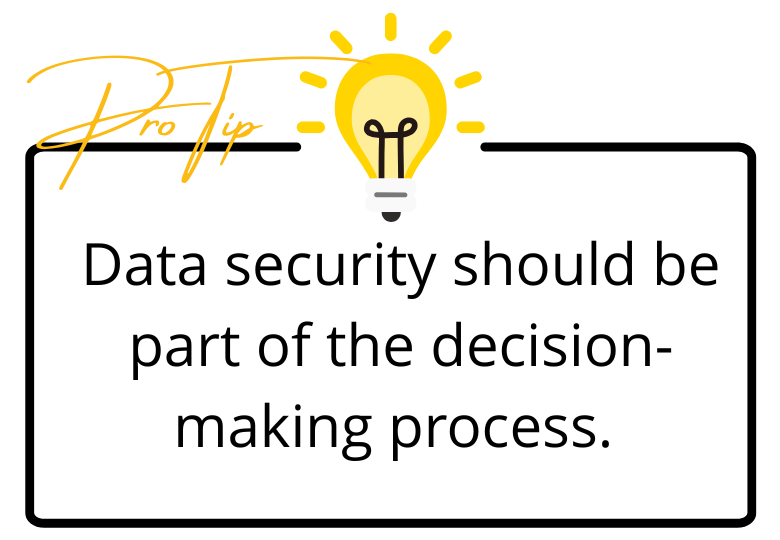 PRO TIP: As you evaluate new tools, security should be part of the conversation too, especially when systems store financial, payroll, HR, or customer data. The SBA offers practical cybersecurity guidance for small businesses, and NIST’s Small Business Quick-Start Guide is a useful resource for SMBs that want a more structured approach to protecting systems and data.
5. Adoption
Can our team realistically adopt and maintain it?
A tool may be powerful, but if it’s too complex, poorly implemented, or dependent on one already-overloaded person, it can quickly become expensive shelfware.
Strong adoption requires more than implementation. It requires ownership, training, process alignment, and follow-through.
The question is not just whether the software can do the job. The question is whether your business can support it well enough for it to succeed.
What Are Signs Your Tech Stack Is No Longer Working?
- Your team enters the same information more than once
- Reporting requires manual work across multiple systems
- Side spreadsheets are managing core workflows
- No one fully trusts the data
- Important processes live in people’s heads instead of in systems
- You are paying for software that only part of the team uses
- A tool was purchased to solve a problem, but adoption never happened
- Teams blame the system, but the real issue is unclear ownership
- Every new hire learns a different workaround for the same task
If this sounds familiar, your business probably doesn’t need more tools right now.
It likely needs better integration, cleaner processes, fuller adoption of the tools you already have, or, in some cases, replacement.
Diagnose before you buy.
A Smarter Technology Strategy for the Messy Middle
Before adding new software, step back, map the workflow, identify the pain points, clarify ownership, and review where data gets stuck before you decide. The right technology should reduce friction, not create more of it.
That is how growing businesses create more clarity and less operational drag.
If your systems have multiplied faster than your processes, you are not alone. Growth has a way of exposing where technology is helping and where it is quietly getting in the way. The goal is not more software. The goal is the right software, working the right way, for the business you are building now.
HireEffect’s technology-forward approach can help, combining the right tools with practical support for growing, owner-led businesses.
Let’s have a conversation.