
If your business is growing but the ride suddenly feels bumpier than expected, you may have entered what Les McKeown calls the whitewater stage of growth.
Here is what many founders discover next.
Revenue is up, new opportunities are coming faster, and everyone is crushing it. But the systems, the team, and the clarity that carried you this far are suddenly under strain. Growth creates pressure and complexity. Pressure and complexity expose inefficiencies quickly.
For many founders, this is the moment when a new problem appears: the team is busy, talented, and working hard, but progress suddenly feels harder than it used to.
In earlier parts of our Scaling Through the Messy Middle series, we talked about pressure showing up as back-office bottlenecks and a lack of financial visibility. It also shows up in building teams and protecting internal culture.
One of the most common things I hear from founders in this stage is: “I hired good people, but I don’t think we’re pulling in the same direction.”
So, now we get to the part that makes or breaks the ride. Because in whitewater, you do not need more “hands.” You need the right crew.
In the early days of a company, culture happens naturally. The founder is involved in everything. Decisions are quick. Everyone understands the vision, mission, and values because they work alongside the person who created them. Culture runs on proximity. You can course correct in the moment, everyone hears the same updates, and you can personally reinforce “how we do things here.”
As the company grows, that closeness begins to stretch, and the business becomes more complex than one person can manage alone. People get hired, and now, instead of everyone reporting to you, people are reporting to people who report to you.
It’s at this stage that many companies quietly enter the messy middle. The team that helped you reach this stage may not yet have the structure or shared clarity needed for what comes next. At this point, culture can no longer be accidental; it has to run on clarity. It has to become intentional.
Values are not wall art. They are your decision system.
When you define them clearly (and hire, onboard, and coach to them), they become the guardrails that keep the raft upright when the water gets choppy.
Why Values-Based Hiring Matters During the Messy Middle
A company’s core values become most important as it begins to scale. When they’re written as actions, rather than ideals, they act as a decision framework for everything you do. They guide hiring, shape behavior, and influence the way people solve problems, even when you’re not in the room.
Without shared values, growth creates friction. Teams pull in different directions, creating silos. Molehills become mountains, and leaders spend more time mediating issues than building the business. People behave the way they want to, not necessarily the way you want them to.
When values are clear, actionable, and practiced consistently, they create behaviors that work in powerful ways. Culture follows what leaders notice, reward, and tolerate. Reinforcing the culture creates alignment, and alignment reduces friction, allowing the organization to move faster and with more confidence.
Hiring for Capability Is Not Enough
Many founders in the messy middle hire primarily for experience or technical skill. That makes sense when the business is under pressure and work needs to get done quickly. But skills alone rarely predict long-term success inside a growing organization.
Two candidates may both be technically strong. One strengthens the culture and improves collaboration. The other introduces tension that spreads through the team. The difference is not skill. It is alignment.
Values-based hiring does not mean choosing personality over competence. It means evaluating both. A strong hire should contribute to the company’s mission and the way it chooses to operate.
Values Become Real Through Leadership
Posting values on a wall does not make them real. People learn what the organization values by watching its leaders.
If leaders prioritize transparency, the team will feel safe raising concerns early.
If leaders demonstrate accountability, employees will take ownership of their work.
If leaders treat people with respect during difficult moments, trust grows across the organization.
Leadership behavior sets the cultural standard far more than written policies ever will.
Practical Ways to Strengthen a Values-Driven Team
Founders often ask how to translate values into something practical. A few simple actions can make a meaningful difference.
Define values in everyday language.
Avoid vague words that mean different things to different people. Describe what each value looks like in action. As an example, HireEffect’s number one core value is putting people first. Here is how we explain it.
We Put People First: We do whatever it takes to meet our commitments. We strive to always act for the greater good. We put our reputation before our profits. We value output, not hours put in.
Use values in hiring decisions.
Ask candidates about real situations they have handled and how they approached them. Look for alignment with how your organization operates. Two questions I like to ask during an interview are:
In what type of environment do you feel you thrive?
If you have an open office and value collaboration and transparency, and a candidate thrives in a traditional office environment where they can be left alone to do their job, you need to explore that further.
What are the three things that are most important to you in a job?
If those three things are not in your top five, again, dig deeper.
Side Note: Check out my article in The Woodard Report for more interview questions.
Recognize behaviors that reflect your culture.
Acknowledging examples of teamwork, accountability, or initiative reinforces what matters.
Create clarity around roles and expectations.
Values support culture, but structure supports execution. When people understand their responsibilities, and they know how success will be measured for the role, performance improves.
If you want to take values beyond philosophy and into operations, here are a few ways founders can build them directly into hiring, onboarding, and leadership rhythms.
PRO TIP: Create a Values-to-Behaviors Map
Most founders skip this step, then wonder why their “values-based culture” feels… open to interpretation.
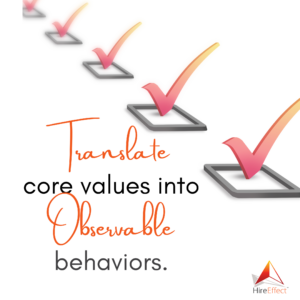
Here’s the fix: translate each value into observable behaviors.
Use this simple 4-part map for every value:
- We believe: (the principle)
- We do: (what it looks like in action)
- We do not: (the line you will not cross)
- We reward: (what gets recognized and repeated)
If you do nothing else after reading this post, do this exercise. It turns values into a shared language your team can actually use.
Hiring in the messy middle: skills get you started; values keep you steady.
Culture Is the Foundation for Sustainable Growth
As companies scale, many founders focus first on systems, processes, and financial metrics. Those elements are essential to survival. As you continue to scale, you need the right people working together in the right roles.
A values-driven team provides stability during periods of rapid growth. It helps organizations navigate challenges without losing their identity.
It also creates an environment where people want to stay and contribute their best work.
Growth brings complexity.
The right culture helps your team move through it with clarity and confidence.
The Values-based Hiring Framework
Step 1: Write a “values-forward” job post
Add a short section called: “How we work” and list 3–5 bullet behaviors (from your Values-to-Behaviors Map). This self-selects candidates before you ever schedule an interview.
Step 2: Use a scorecard, not vibes
Before interviews, define:
- Outcomes for the role (what must be true in 90 days)
- Competencies (what they need to know)
- Values behaviors (how they need to operate)
HireEffect uses role scorecards with responsibilities, key metrics, and expectations as a foundation for performance and development.
Step 3: Interview for values with real scenarios
Ask candidates how they handled situations similar to the realities of your business. Include a future teammate in the conversation. Peers often spot misalignment that leaders miss.
Here are a few founder-friendly prompts you can steal:
- “Tell me about a time you made a mistake that impacted a customer. What did you do next?”
- “When priorities shift mid-week, how do you reset expectations with your team?”
- “What does accountability look like when you are blocked and waiting on someone else?”
Onboarding: turn values into habits (before bad habits form)
Onboarding is where culture becomes real. It is also where most founder-led businesses accidentally create inconsistency.
A strong values-driven onboarding does three things:
- Connects to purpose
“Why do we exist, and why does this role matter?”
(At HireEffect, every new hire hears the founder’s story during onboarding because purpose needs context.) - Creates clarity
What good looks like, how work flows, who owns what. - Builds belonging
People do better when they feel like they matter.
The 30-60-90 “Whitewater-Proof” onboarding plan
- First 30 days: learn, shadow, master the basics, relationships
- 60 days: own recurring outcomes, start improving one process
- 90 days: hit role KPIs, contribute to an improvement, demonstrate values in action
Pro tip: add one “values win” to the 30-60-90 plan. Example: “By day 60, share one example of how you drove change or embraced accountability in your workflow.”
Your Culture Operating System
Culture does not scale through inspiration. It scales through rhythm.
Here is a lightweight operating system that works even if you hate meetings:
- Weekly 1:1s (leader to team member): remove blockers, coach, align priorities
- Weekly leadership sync: share patterns, coordinate, make decisions
- Monthly pulse check: quick engagement feedback (anonymous is best)
- Quarterly all-hands: vision, progress, recognition, what is next
HireEffect uses regular 1:1s, leadership collaboration, and intentional connection points to keep a remote team aligned and engaged.
And yes, recognition is part of the system, not a nice-to-have. HireEffect reinforces culture through celebration, shout-outs, and a dedicated Kudos channel.
Accountability without micromanagement
In whitewater, founders often swing between two modes:
- “I trust you, just figure it out” (and then panic when it goes sideways)
- “I will check everything” (and then become the bottleneck again)
The bridge is clear expectations + frequent, lightweight check-ins.
Use this simple accountability formula:
- Outcome: what must be true
- Owner: who owns it
- Cadence: how often it is reviewed
- Escalation: what happens when it is at risk
This pairs perfectly with the “Weekly Pulse” approach you saw in the metrics post.
Compliance considerations that protect your culture (and your cash)
A values-driven culture also requires operational discipline and can’t replace compliance. It makes compliance easier because expectations are clearer and follow-through is stronger.
As you scale, put these on your “do not ignore” list:
- Employee classification: misclassifying people gets expensive fast
- Multi-state employment and payroll rules: complexity multiplies as you hire across state lines
- Handbook and policies: especially PTO, remote work, timekeeping, and conduct
- Consistent onboarding documentation: offer letters, I-9s, required notices, and new hire reporting
- Performance documentation: fair, consistent, timely (protects people and the business)
If you are not sure what applies to your business, work with an HR advisor (and employment counsel when needed). This is one of those areas where “winging it” is wildly overpriced.
Final thought: your values are the paddle strokes
Whitewater is not a sign that you are failing. It is a sign that your business is growing.
And growth requires a crew that can paddle in sync.
When values are clear, behavior-based, and built into hiring, onboarding, and leadership rhythms, you get the kind of team that:
- makes good decisions without waiting on you
- protects customers and culture at the same time
- helps you steer toward calmer waters
And perhaps most importantly, it allows the founder to step out of constant reaction mode and back into the role the business needs most: leader.
If you want help building that kind of team, let us know. HireEffect supports founder-led businesses with recruiting, People Operations, payroll, and the systems that make culture scalable, not accidental.
BONUS: We’re doing a deeper dive in our LinkedIn Newsletter “Clarity for What’s Next” and would love for you to subscribe!
This article was drafted by AI, with prompts, edits, and final compilation by Jennifer Scott, founder and CEO of HireEffect.