

Quick answer
Your bookkeeper makes sure every transaction is recorded accurately and on time. That work is essential, and it is not the same as someone reading those books and using them to keep the business compliant, disciplined, and out of trouble. That second job is controllership. Bookkeeping records what happened. Controllership takes those records and uses them to guide decisions, stay ahead of what you owe, and protect the money. Most growing businesses pay for the first job and quietly assume the second one comes with it. It does not, and the gap is where money leaks, risk hides, and big decisions get made on gut instead of numbers. Here is who is supposed to be reading your books, what they should be catching, and how to tell whether that job is being done at your company.
Two different jobs, one set of books
Most owners picture the money side of the business as one job: the person or team who does the books. But there are really two jobs in there, and they are different disciplines.
The first is bookkeeping. It records what happened. Every sale, every bill, every payment, categorized correctly and reconciled so the records are accurate and current. This is the foundation, and without it, nothing else works. A strong bookkeeper also keeps a dependable, clean close and fixes the process behind it as they go.
The second is controllership. It works from the reliable numbers your bookkeeping produces and puts them to work: keeping you compliant, protecting your cash, and guiding your decisions. It’s a defined discipline, not a vague, more strategic version of bookkeeping.
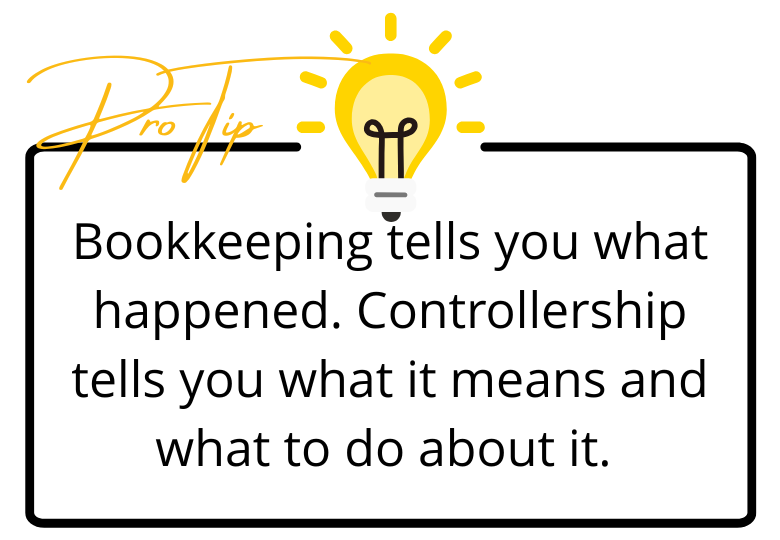
Here is the simplest way to hold the difference. Bookkeeping tells you what happened. Controllership tells you what it means and what to do about it. You can have beautifully accurate books and still be flying blind, because nobody is doing the second job.
What a controller actually owns
Controllership is not a fuzzy upgrade to bookkeeping. It’s a defined discipline. Woodard, a leading source of coaching, education, community, and resources in our field (and our own coach here at HireEffect) (link to plan), frames it as three roles, and together they draw a clean line between keeping the books and running the business on them.
Regulatory compliance. Anticipating and adapting to change, and staying ahead of what you owe and when. Sales tax, payroll tax, franchise tax, and the filing deadlines that carry real penalties when they slip. This is the job that keeps a surprise notice from ever landing on your desk.
Managerial governance. Ensuring operational decisions are made in line with approved policies and risk management frameworks. The guardrails that keep spending intentional as you grow. Spend and purchasing policies and an operating budget you actually measure against, so money moves on purpose rather than by habit. Robust policies and training ensuring all employees understand their roles and the consequences of non-compliance.
Risk mitigation. The controls that protect the money. Internal controls so no one person owns a transaction from start to finish, receivables monitoring so cash you earned doesn’t quietly age into bad debt, and the people-and-payroll compliance that sits right beside the money: worker classification, payroll tax, and the wage and hour rules where a single missed detail gets expensive fast.
Notice what those three have in common. Every one of them protects your business. Your bookkeeping records the past accurately, which is essential. Controllership takes those accurate records and uses them to keep you compliant, disciplined, and out of trouble. That’s the difference between having good books and putting them to work.
Where the money and the people meet
Here is the piece most oversight setups miss. That third function, risk mitigation, runs straight through your people. Payroll tax, worker classification, onboarding paperwork, and wage and hour rules are financial risks and people risks at the same time. A controller who watches the books but has no line of sight into HR and payroll is only covering half of it, and the half they miss is where some of the costliest surprises live.
This is where an outsourced team that already runs your bookkeeping, payroll, and HR has a real edge over a finance-only controller. The same people watching the money are watching the compliance that sits next to it, so nothing falls in the gap between two vendors who each assume the other has it. That combination is rare, and it is exactly the seam where owner-run businesses get caught.
What goes unused, and what it costs
When nobody’s doing that second job, you don’t feel it right away. You feel it later, as a surprise, and surprises are the most expensive way to run a business.
The compliance surprises sting the most because they’re also the most preventable. Payroll tax is a classic example. Roughly 40% of small businesses get hit with a payroll tax penalty in a given year, averaging about $845 (IRS data), almost always for a timing or filing error that a review layer would have caught before the money ever left the account. That’s a bill you pay for the absence of oversight, not for anything you actually did.
Then there are the slower leaks. Cash you earned but can’t touch because an invoice quietly aged past due, spending that crept up because no budget was in place to flag it, or a gap that let one person request, approve, and pay without a second set of eyes. None of these trips an alarm. They just cost you month after month until they’ve reached a threshold that triggers a review.
Here’s the part worth sitting with: none of these are bookkeeping failures. Your books can be flawless while every one of these risks runs unwatched. Recording the numbers correctly and using them to protect the business are two different jobs, and it’s the second one going undone.
But my books are accurate. Isn’t that enough?
This is the most common pushback we hear, and it is a fair one. Accurate books are a genuine accomplishment, and plenty of businesses don’t even have that. Here’s the subtlety: accurate and decision-ready still aren’t the whole job. Your records are correct and current, and a strong bookkeeper keeps a close eye on them and can tell you exactly what they say. That’s real, and it matters. But the gap is what happens next. Having decision-ready numbers and actually using them to run the business are two different things. Someone still has to pick those numbers up each month and act on them: pressure-test the big spend, stay ahead of the tax and payroll deadlines, tighten a control before it’s tested, chase a risk while it’s still small.
So, this isn’t flying blind for lack of instruments. The instruments are built, calibrated, and right in front of you. What’s missing is a hand on the wheel.
So, who should be reading your books?
Someone has to do the second job. The question is who, and the honest answer depends on your size and stage. Here are 5 options.
- You, the owner. In the early days, this is you, at night, with a coffee and a spreadsheet. It works until it doesn’t, and it fails fastest right when you are growing, and your attention is most valuable somewhere else.
- Your bookkeeping team. A strong bookkeeper is worth their weight, builds a dependable close, and fixes process as they go. Controllership is a different job layered on top, with its own training and mandate. The best setups pair the two rather than asking one person to quietly be both, and a great bookkeeping team is exactly what makes that oversight layer work.
- A full-time controller. Once your volume and complexity justify it, an in-house controller is the natural answer. Just know that a fully loaded controller salary is a serious commitment, often well into six figures, and many owner-run businesses reach the need for the role long before they can justify the cost. Also, most in-house controllers focus solely on finance, leaving HR and payroll compliance to someone else.
- A fractional controller. For some owner-run businesses, this is the sweet spot. You get senior financial oversight for a fraction of a full-time salary, with the systems and the review layer included, and the right provider can cover the people-and-payroll side in the same engagement. We break down what that actually costs here. How much does a fractional controller cost?
- Your CPA. Worth naming, because if your CPA works with you monthly and reviews your books, they can certainly play this role. Some owners assume tax time covers it. It does not. Your tax preparer files what already happened, once a year. Controllership is continuous, forward-looking, and built to change outcomes while you can still act.
How to tell nobody’s reading your books
There are clear tells that the second job is not getting done. A few of the loudest:
- Your reports are accurate, but still can’t tell you whether you can afford your next big move.
- Month-end close lands at a different time every month.
- Financial surprises keep finding you.
- One person handles money from start to finish with no second set of eyes.
- Chasing unpaid invoices has become your part-time job.
- Your budget lives in your head.
- Every time you grow, the finances get messier instead of clearer.
One of these might just be a rough month. Two or more is a pattern, and the pahttps://hireeffect.com/jscott/ttern is telling you the books are being kept, and even read, but nobody’s acting on them. We walk through the full checklist and what each sign really means in 7 Signs Your Business Has Outgrown Basic Bookkeeping.
Ready to find out who’s reading yours?
If you are not sure anyone is actually reading your books, that’s worth a conversation.
Here’s a question to sit with: when your next big decision comes across both your finances and the people-and-payroll compliance that rides along with them, will the answer be in your numbers or in your gut?
FAQ
What is the difference between a bookkeeper and a controller?
A bookkeeper records and maintains accurate financial transactions, and a strong one keeps a dependable, clean close. A controller works from those records to run three jobs on top: regulatory compliance such as sales tax, payroll tax, and franchise tax; managerial governance like spend policies and operating budgets; and risk mitigation like internal controls, receivables monitoring, and the payroll and people compliance that sits next to the money. Bookkeeping tells you what happened. Controllership uses it to keep you compliant, disciplined, and out of trouble.
What is controllership?
Controllership is the layer of financial oversight above day-to-day bookkeeping. It’s the oversight and management of an organization’s financial activities, ensuring accurate reporting, compliance, and strategic financial guidance. It puts your financial information to work, keeping you compliant, disciplined, and ahead of risk.
Does controllership cover HR and payroll compliance?
It can, and this is where providers differ. Worker classification, payroll tax, and wage and hour rules are financial risks that sit right next to the books, so they fall inside the risk-mitigation side of controllership. Many finance-only controllers leave them to a separate HR vendor. A provider that already runs your bookkeeping, payroll, and HR can watch both with one team, which closes the gap where those two worlds usually meet.
Do I need a controller, or just a better bookkeeper?
If your books are late, messy, or inaccurate, you may need stronger bookkeeping first. If your books are accurate but still can’t guide your decisions or cover your risks, that is a controllership gap, and a better bookkeeper alone won’t close it. Many businesses need both: solid bookkeeping to produce the records and controllership to put them to work.
Is a fractional controller worth it?
For many owner-run businesses, yes. A fractional controller gives you senior financial oversight, compliance, and controls for a fraction of a full-time salary, which makes it a strong fit for a business that has outgrown basic bookkeeping but is not large enough to justify a full-time executive hire. See How much does a fractional controller cost? for the numbers.
2 thoughts on “Your Bookkeeper Keeps the Books. Who’s Reading Them?”