

Growth has a funny way of exposing what used to work just fine. For many growing businesses, that’s when process improvement, SOPs, and clearer accountability stop feeling optional and start feeling necessary.
In the early days, most founder-led businesses operated on trust, hustle, and a lot of verbal handoffs. Someone knew how to do payroll because they always ran payroll. A client issue got solved because the right person happened to catch it. A process existed, but only in one team member’s head and maybe on three sticky notes, a spreadsheet, and a prayer.
That can work for a while.
But as a business grows, the cracks start to show. Things get missed, work gets duplicated, accountability gets fuzzy, and team members begin solving the same problem in five different ways.
The founder becomes the default answer key for every question, which is exhausting and expensive.
This is usually the point when business owners realize they need more structure. Then comes the concern right behind it:
“Process feels like micro-management. Won’t too much process slow us down?”
This is part six of our Scaling Through the Messy Middle series.

Why Process Improvement and Standardization Matter in Growing Businesses
Good standardization is not about bureaucracy. It’s about creating enough consistency so that your business can move faster, with less confusion and less dependence on any one person. The goal isn’t to make your company rigid. The goal is to make it reliable.
When businesses are small, inconsistency can hide in plain sight. Everyone is close enough to the work to fill in the gaps. Once you add more people, more clients, more locations, or more complexity, those gaps become more expensive.
Lack of standardization often shows up as:
- Team members doing the same task differently
- Delays caused by constant clarifying questions
- Work getting stuck because only one person knows the next step
- Repeated mistakes that should have been prevented
- Managers spending too much time chasing status updates
- Founders feeling like delegation “never really works”
That’s usually not a people problem.
More often, it’s a process problem.
When expectations are unclear and processes are inconsistent, even capable people struggle to perform at their best. They are not failing because they are careless. They’re working without enough support, context, or structure to succeed consistently.
That is where SOPs, accountability, and process improvement come in.
What Standardization Actually Means
Standardization does not mean scripting every move your team makes. It doesn’t mean stripping away judgment, creativity, or flexibility. It means being clear about the parts of the work that should happen the same way every time.
Think of it this way: Your business should not need to reinvent recurring work.
If something happens regularly, affects clients, touches compliance, impacts revenue, or creates risk when missed, it deserves a defined process.
That process might include:
- What needs to happen
- Who owns it
- When it should happen
- What “done right” looks like
- Where the information lives
- What to do if something is off track
That is not red tape. That is operational clarity.
And clarity is what gives people the confidence to move without constantly stopping to ask for permission.
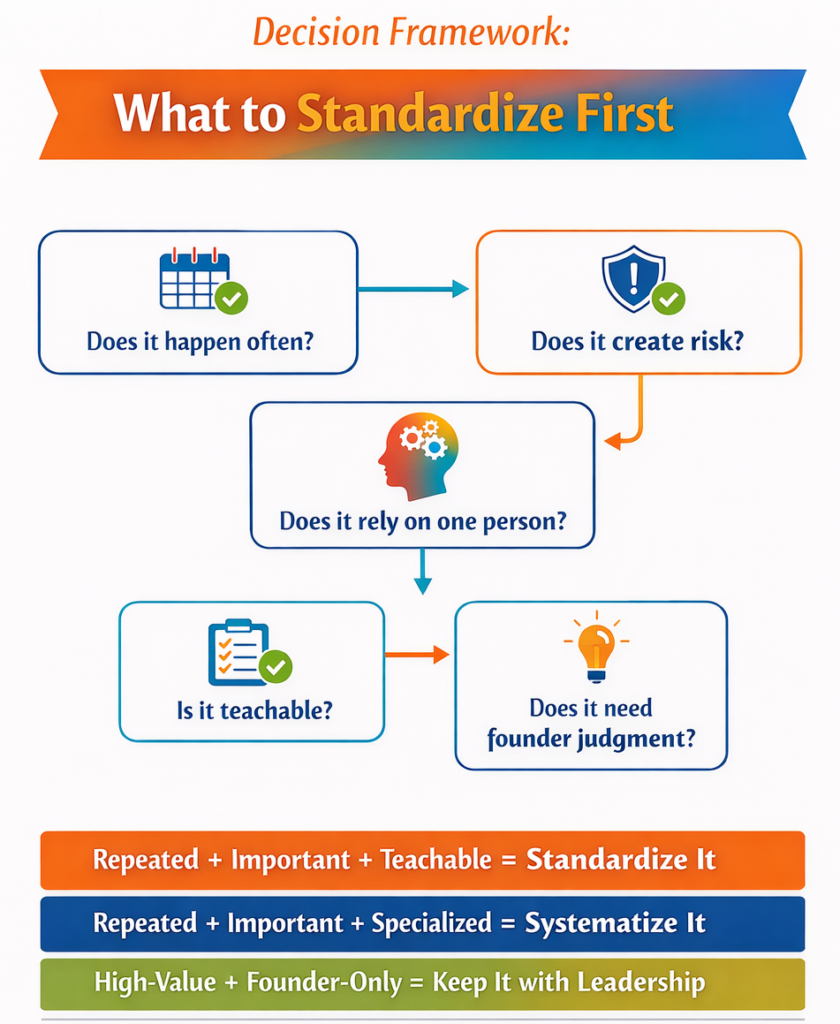
If the idea of creating SOPs and improving processes feels overwhelming, don’t start by trying to document everything. Start by asking the right questions.
Does this happen often?
If it shows up weekly, monthly, every payroll cycle, every month-end, or every time a client or employee moves through a process, it probably should not live in someone’s memory.
Does it create risk if it is missed or handled inconsistently?
Anything tied to money, deadlines, compliance, reporting, approvals, or the client experience deserves more consistency than “however we usually do it.”
Does too much of it rely on one person’s head?
If the process works only because one person remembers the steps, catches the issues, or knows the exceptions, it is more fragile than it looks.
Does it slow the team down because people keep asking questions?
If your team regularly has to stop and ask how to handle something, that is a sign the process is not clear enough yet.
Is it teachable and repeatable?
Not every task is simple, but many are still repeatable. If the core steps can be taught, documented, and consistently followed, they’re a good candidate for standardization.
Pro Tip: If a task is repeated, important, and teachable, standardize it. If it is repeated, important, and specialized, systematize it with the right owner and tools. If it truly requires founder-level judgment, keep it with leadership.
Impact? You will create more structure without creating unnecessary drag.
Why Founders Resist SOPs and Systems
I understand the hesitation. A lot of founders have had a bad experience with “process” before.
Maybe they have seen a bloated manual no one uses.
Maybe they have worked inside a company where layers of approval killed momentum.
Maybe they hear the phrase “standard operating procedures” and immediately picture a dusty binder nobody has opened since 2017. Fair enough.
But the answer is not to avoid systems. The answer is to build better ones.
I went through my own journey with SOPs. We had no idea what the undertaking actually was. It wasn’t until we hired a project manager to get us over the finish line that we made traction. Now? Our team relies on the SOPs for handoffs, taking time off, and, especially, training new hires.
The best SOPs are practical. They are easy to find, easy to follow, and easy to update. They support the work instead of getting in the way of it.
A good process should help your team make better decisions faster, not trap them in unnecessary steps.
A useful SOP does not need to be fancy. In fact, simpler is usually better. You can start with:
Purpose
Why this process matters
Owner
Who is responsible for making sure it happens
Steps
What happens, in order
Timing
When it happens and any deadlines involved
Tools or systems used
Where the work is completed or tracked
Exceptions or escalation points
What to do when something is not standard
That is enough to create consistency without writing a novel.
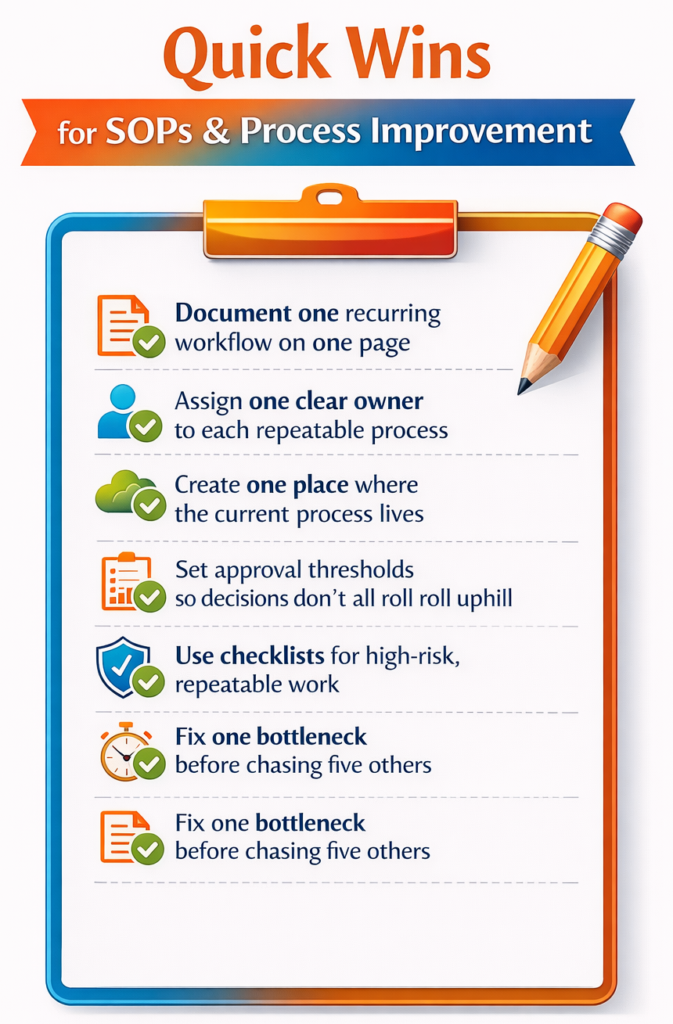
Quick Wins to Improve Business Processes This Quarter
You do not need a giant operations overhaul to make meaningful progress. A few simple changes can reduce confusion quickly and make the business easier to run.
Document one recurring workflow on one page.
Pick one process your team repeats often. Write down the owner, the steps, the timing, and where the work is tracked. Keep it simple enough that someone would actually use it.
Assign one clear owner to each repeatable process.
Even if several people touch the work, one person should own the outcome. When multiple people are accountable for the same thing, nobody is actually accountable.
Create one place where the current process lives.
If instructions are spread across email, chat, and someone’s memory, you do not really have a process. You have a scavenger hunt.
Set approval thresholds.
Not every decision needs to roll uphill. Clarify what managers or team leads can approve on their own and when to escalate.
Use checklists for high-risk work.
For anything tied to money, deadlines, compliance, or client deliverables, a simple checklist can go a long way.
Fix one bottleneck before chasing five others.
Choose the place where work gets stuck most often and clean that up first. Momentum is more useful than a perfect master plan nobody finishes.
Review the process with the people who do the work.
The goal is not to create documentation that looks impressive. The goal is to create something your team will actually follow.
Protect time for the work only leadership should be doing.
As you standardize and delegate more of the repeatable work, be intentional about what fills that space. Founder time should go toward leadership, strategy, relationships, and decisions that genuinely require that level of judgment.
A Quick Founder Self-Check
If any of these sound familiar, it may be time to standardize:
- “Everyone seems to do this differently.”
- “I am still the only one people come to for the answer.”
- “I know I have explained this more than once.”
- “This keeps getting delayed, even with good people involved.”
- “I know we need a process, but nobody has written it down.”
- “When one person is out, everything slows down.”
The Difference Between Standardization and Rigidity
This is the part that matters most.
Standardization should create a dependable framework. It should not eliminate professional judgment.
In growing businesses, not every situation is identical. Clients are different. Employees are different. Problems are different.
Your systems should account for that.
A healthy process says, “Here is the standard way we handle this, and here is when judgment comes into play.”
That distinction matters.
Without standards, every situation becomes a custom project, ultimately wasting time and creating inconsistency.
Without flexibility, your team becomes afraid to think. That creates bottlenecks and delays.
The sweet spot is structure with room for judgment.
Accountability Without Micromanagement
Yes, accountability matters, but you don’t want to create a culture that feels controlling or heavy-handed. Nobody does their best work when they feel watched every second.
But avoiding accountability does not create trust. It creates ambiguity.
Real accountability is simply clarity plus follow-through.
People need to know what they own. They need to know what success looks like. They need visibility into whether things are on track. And when something is not working, there needs to be a way to address it early, not after it has become a bigger issue.
If your team is hearing “just use your judgment” when the real need is a defined owner, a deadline, and a clear result, that is not empowerment. That is abdication in a nicer outfit.
A strong accountability structure usually includes:
- Clear ownership of outcomes
- Defined deadlines or service expectations
- Visibility into progress
- Consistent follow-up
- Willingness to improve the system when the work breaks down
The point is not to police people. The point is to make it easier for good people to succeed.
How to Improve Processes Without Slowing Down the Business
Process improvement sounds like a big initiative, but it often starts with paying attention to the same friction points that keep showing up.
If your team keeps asking the same question, there is probably a missing process.
If work keeps stalling in the same place, there is probably an ownership issue.
If something keeps getting done late, there may be a problem with the workflow design.
Not every process problem needs a new tool. Sometimes it just needs a clearer decision.
A process is probably working if:
- Team members can follow it without chasing clarification
- Results are more consistent across people and clients
- Errors or missed steps decrease
- Handoffs are smoother
- Training new team members gets easier
- The founder is no longer the backup system for everything
A process is probably not working if your team avoids it, ignores it, or has to work around it constantly to get real work done.
Systems should evolve as the business evolves. What worked at 10 employees may not work at 25. What worked with one service line may not work with four. You are allowed to refine as you grow.
In fact, you should.
Keep SOP Documentation Useful, Not Impressive
This is one of my strongest opinions on the topic.
Your SOPs do not need to be beautiful. They need to be useful.
A screen recording, a checklist, a shared template, or a one-page how-to can be far more effective than a polished but bloated process document no one reads.
Ask yourself, “Would a real person use this during their actual workday?”
If the answer is no, keep simplifying.
The point is adoption, not admiration.
Technology Should Support the Process, Not Replace the Thinking
It can be tempting to look for a software fix every time operations feel messy. Sometimes the right tool absolutely helps. Sometimes it just digitizes confusion.
Before adding new technology, make sure the process itself makes sense. I’ve said for years, “Adding technology to a broken process only creates a faster broken process.”
A shaky workflow does not become a strong workflow because it now has a login and a dashboard.
Get clear on the process first. Then use technology to reinforce consistency, improve visibility, reduce manual effort, and support accountability.
That is where systems become genuinely helpful.

The Real Payoff of Standardization and Systems
When businesses standardize the right things, a few important shifts happen.
- Delegation improves because expectations are clearer.
- Training gets easier because knowledge is no longer trapped in one person’s head.
- Managers spend less time chasing and correcting.
- Clients get a more consistent experience.
- Founders get pulled out of fewer preventable fires.
- And perhaps most importantly, the business becomes less fragile.
That matters.
Because if your company only works when the founder is constantly checking, answering, approving, reminding, and rescuing, it is not really scalable yet. It is just surviving on effort.
You, the Founder? You don’t have a business; you have a job.
Systems create resilience. Not because they make your business less human, but because they make it less chaotic.
Final thought
Standardizing and systematizing does not mean building a business that feels stiff or corporate. It means building one that can grow without everything getting harder every quarter.
You do not need more process for the sake of process.
You need the kind of structure that protects clarity, supports accountability, and gives your team a consistent way to do good work.
That’s not the enemy of agility. It’s what makes agility sustainable.
If your business is in that stage where growth is exposing operational gaps faster than your team can patch them, that’s not a failure. It is a signal. And it’s a very normal one.
The good news is that with the right systems in place, you do not have to choose between structure and flexibility.
You can build both.
Frequently Asked Questions
What is the difference between standardizing and systematizing a business?
Standardizing means creating consistency in how repeatable work gets done. Systematizing means building the people, tools, and structure that support that consistency at scale.
When should a growing business create SOPs?
A growing business should create SOPs when recurring work starts depending too heavily on memory, causes repeated questions, creates risk, or slows down handoffs.
Do SOPs make a business less agile?
Not when they are built well. Good SOPs reduce confusion and create clarity, making it easier to move quickly.
Let’s talk about how we can help you create clarity.
This article was drafted by AI, with prompts, edits, and final compilation by Jennifer Scott, founder and CEO of HireEffect.